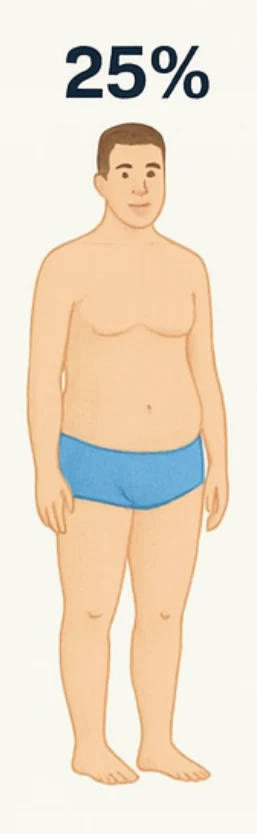
What 25% body fat looks like on a man
The belly is flat at rest but has no definition; shoulders are wider than the waist, muscle outlines show, abs do not.
What you see
Standing relaxed, the belly looks flat or nearly flat, yet there is no definition on it — the skin is smooth and the separations between muscles do not read. The shoulders are noticeably wider than the waist and the silhouette takes on a V shape. Flexing the arms shows the outline of biceps and triceps, but without separation between the heads. A fold at the flank is easy to pinch, and sitting down gathers the belly into a soft roll.
What it means
25% is both the top of the average range for men and the bottom edge of obesity. From a health standpoint it is acceptable: with normal blood pressure, glucose and lipids there is nothing to worry about.
For endurance sport it is already dead weight. Every extra kilogram costs energy over a distance: in running, added mass worsens running economy almost linearly, and the difference between 25% and 15% for a marathoner is several minutes on the clock.
Getting to 20%
This is where simply "eating less" stops working on its own — the body pushes back harder.
- A moderate deficit: 300–400 kcal. A pace of 0.3–0.5 kg per week, slower but with your capacity to train intact.
- Do not cut carbohydrates entirely if you train for endurance: session quality will drop before your body fat does. You can work out your glycogen stores in the carbohydrate depot calculator.
- Watch the long gaps without food. At this level managing hunger matters more than the choice of any particular diet.
A visual estimate gives a range, not an exact number: at the same percentage, physiques differ by muscle mass and fat distribution.