What 30% body fat looks like on a man
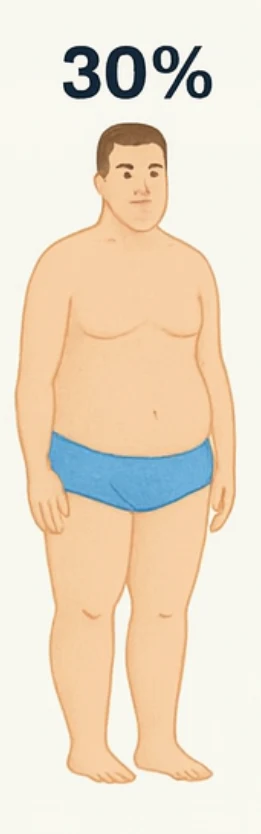
The belly is round but no longer hangs over, the waist roughly matches shoulder width, and muscle can be guessed at under the fat layer.
What you see
The belly is still round and projects forward, but the fold hanging over the waistband is gone. The waist is roughly as wide as the shoulder girdle, and the silhouette is straight. The chest is soft, without a clear lower border. Arms and legs look full, yet their shape is readable: you can see where the upper arm ends and the forearm begins. The abdominals are not visible at all.
What it means
For a man, 30% is still the obesity range (the threshold is around 25%), but its lower end. The metabolic risk here is already lower than at 35%, and — more to the point — the safe range is one step away rather than three.
One more thing worth remembering: body fat percentage and body weight are not the same thing. A 95 kg man at 30% fat and an 80 kg man at the same 30% sit in the same health category, even though the scale shows a 15 kg gap.
Getting to 25%
The gap to the next figure is about 4–5 kg of fat with muscle mass preserved — two to three months of work in a moderate deficit.
- Protein at 1.6–2.0 g per kg of body weight. In a deficit this is the single most important dietary parameter: it decides how much of the loss comes from fat rather than muscle.
- Strength training becomes mandatory, not optional: without it the body gives up muscle tissue readily.
- Add steps. The difference between 8,000 and 12,000 steps a day is around 150–200 kcal — meaningful over a month, and unlike an extra session it costs you no recovery.
A visual estimate gives a range, not an exact number: at the same percentage, physiques differ by muscle mass and fat distribution.