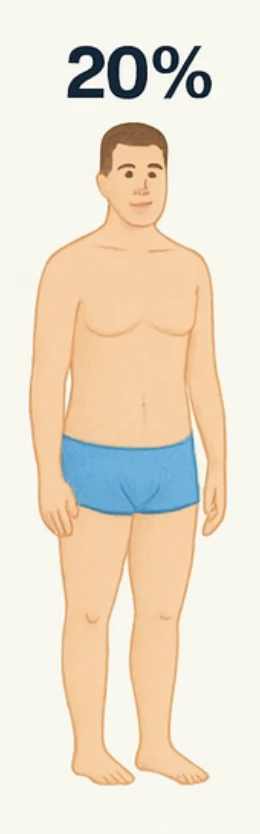
What 20% body fat looks like on a man
The upper abs show when flexed, the waist is clearly narrower than the shoulders, and veins appear on the arms when you are warm.
What you see
The upper abdomen shows when flexed — usually the top two segments, while the lower ones stay hidden. At rest the belly is flat with a little softness low down. The shoulders and chest have a readable shape: you can see the lower border of the pectoral and the outline of the delts. Veins surface on the arms when you are warm or after a session. There is still a fold at the flank, but a thin one.
What it means
20% sits in the middle of the normal range for men. It is a sustainable level: you can hold it for years without policing your food, and it gets in the way of neither health nor training.
For an amateur who runs or rides for their own sake and races a few times a year, this is a sensible point of balance — the body is not in chronic deficit, and neither hormones nor recovery suffer.
Getting to 15%
From here on, results demand attention to detail rather than general discipline alone.
- Keep the deficit small: 200–300 kcal, a pace of 0.25–0.4 kg per week. A steep deficit from this point hits recovery markedly harder.
- Plan the cut outside your racing period. Combining weight loss with a taper is a poor idea: both will suffer.
- Sleep and stress stop being details. At this level, short sleep reliably means more appetite and worse sessions.
A visual estimate gives a range, not an exact number: at the same percentage, physiques differ by muscle mass and fat distribution.