What 15% body fat looks like on a man
Abs visible at rest, obliques defined, the face turning angular — the typical look of a well-trained amateur.
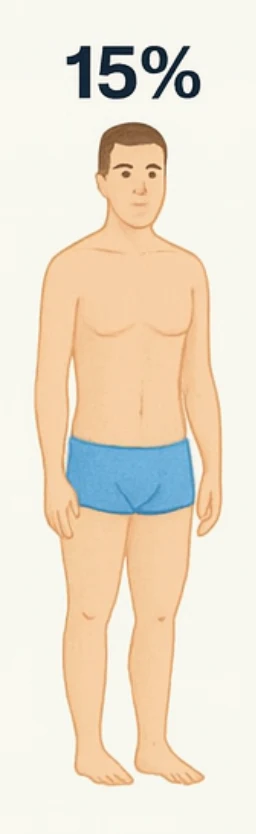
What you see
The abdominals show at rest: the upper and middle segments are visible without flexing, the lower ones appear when you draw the belly in. The obliques are defined and a line reads between the ribs and the pelvis. The face turns angular, with cheekbones and jaw standing out more. Veins on the forearms are permanent, on the shoulders they show under load. The fold at the flank is thin but still pinchable.
What it means
15% is the typical level of a man who trains regularly and arguably the best compromise between appearance, health and quality of life. It sits just above the athletic range (roughly 6–13% in competitors) and demands no restrictions that wreck everyday life.
For amateur runners and triathletes this is working race shape. Going lower yields ever smaller performance gains and ever more risk: testosterone falls, recovery worsens, and injuries and colds become likelier.
Getting to 10%
An honest warning: this step is harder than every one before it, and far from everyone needs it.
- A deficit of 150–250 kcal and patience: 0.2–0.3 kg per week over two or three months.
- Weigh how you feel, not just your food. A dropping libido, permanently cold hands and feet, irritability and vanished motivation to train are all signals to stop.
- Ask yourself why. If the goal is a race result, check whether it is currently limited by volume or technique rather than by surplus kilograms. The performance index will give you a sense of where you stand.
A visual estimate gives a range, not an exact number: at the same percentage, physiques differ by muscle mass and fat distribution.