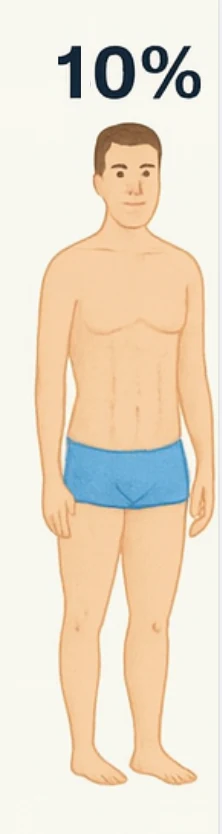
What 10% body fat looks like on a man
A full six-pack, defined obliques, veins on the abdomen and shoulders — race shape that is hard to hold.
What you see
The abdominals are fully visible at rest: all six segments with clear dividing lines. The obliques stand out and the inguinal ligaments form a pronounced V low on the abdomen. Veins surface on the forearms, the shoulders and often the abdomen itself. The face is lean with sharply drawn cheekbones. A fold at the flank is hard to pinch — it is thin, and the skin sits tight.
What it means
10% is competition level. It falls inside the athletic range (6–13% for men) and means training and nutrition have been run systematically for months.
An important caveat: this is peak shape, not a permanent state. Holding 10% year-round leaves most people chronically hungry, with a reduced libido, poor cold tolerance and worse recovery. Athletes typically enter this shape for a few weeks around a target race and then return to 13–15%.
What comes next
Below 10% you enter territory where the risks outweigh the benefits for everyone except competing bodybuilders under supervision.
- Essential fat in men is 2–5%. That is the structural minimum: cell membranes, nerve tissue, hormones. Approaching it disrupts the endocrine system.
- The symptoms of relative energy deficiency (RED-S) — falling performance, frequent illness, stress fractures, mood disturbance. Contrary to popular belief, they do not spare men.
- The sensible tactic is to plan it, not hold it. Peak for the race, then return deliberately to the 13–15% range, where the body works best.
A visual estimate gives a range, not an exact number: at the same percentage, physiques differ by muscle mass and fat distribution.