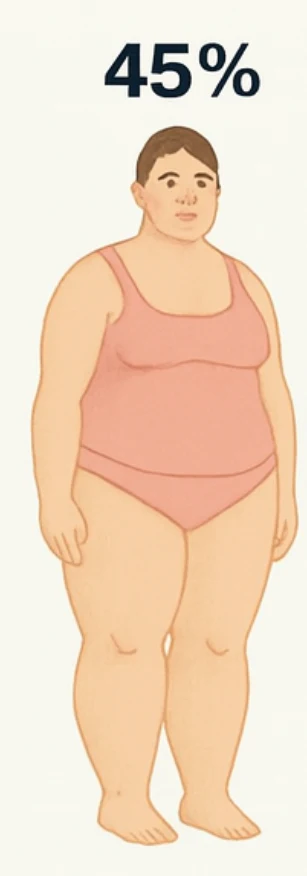
What 45% body fat looks like on a woman
Fullness spread across hips, belly and shoulders, the waist barely expressed, no muscle contours anywhere.
What you see
Fullness is noticeable across the whole figure: hips, belly, shoulders and arms. The waist is barely defined — the transition from ribs to pelvis is smoothed out and the silhouette is close to straight. The belly projects forward and forms a fold at the bottom. Shoulders and upper back are full, and the neck looks shorter because of the layer of fat over it. Muscle contours do not read anywhere.
What it means
For a woman the obesity threshold begins at roughly 32%, so 45% is a pronounced degree of it. Fat distributes differently in women than in men: more in the hips and buttocks, less around the organs, and that offers partial protection from metabolic complications. Partial, but not complete — at this level the risks to blood pressure, blood sugar and joints are real.
Reproductive function deserves separate attention: excess fat tissue shifts the hormonal balance and is often linked to an irregular cycle and difficulty conceiving.
Getting to 40%
Neighbouring figures differ by about five percentage points — 4–6 kg of fat for a woman of average height. A calm pace is 0.5% of body mass per week, so around three months.
- A deficit of 300–400 kcal a day — gentle and sustainable. Crash diets at this level almost always end in regain.
- Walking as the foundation. Seven to ten thousand steps do more than occasional hard sessions, and they cost no recovery.
- Two strength sessions a week preserve muscle and bone density — for women the second matters especially in the long run.
- Protein at 1.4–1.8 g per kg. It is also what holds satiety best. You can estimate your calorie baseline in the BMR calculator.
A visual estimate gives a range, not an exact number: at the same percentage, physiques differ by muscle mass and fat distribution.