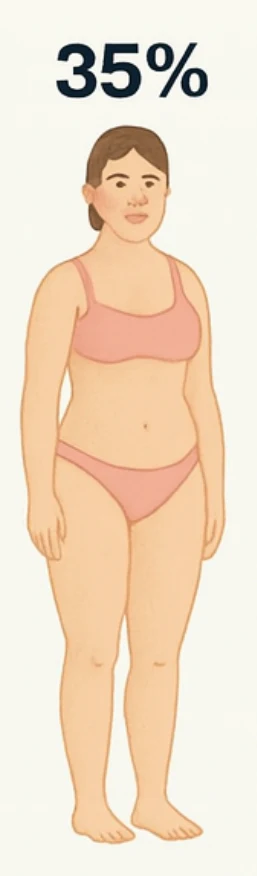
What 35% body fat looks like on a woman
The waist is clearly narrower than the hips, the figure takes on an hourglass shape, the belly is flat standing and soft sitting.
What you see
The waist is distinctly narrower than the hips and the figure takes on an hourglass shape. Standing, the belly looks almost flat; sitting, it gathers into a soft fold. The thighs are round, and the skin at the back of them may show some unevenness — this is normal and only weakly related to body fat percentage. The arms are soft but their shape is visible. There is no muscle definition.
What it means
35% is the upper part of the average range for women, just above the obesity threshold (around 32%). From a health standpoint, with normal blood work, it is acceptable; for endurance sport it is surplus.
Worth remembering that the norms for women are higher than for men by physiology, not tradition: essential fat in women is 10–13% against 2–5% in men, because fat tissue takes part in producing oestrogen.
Getting to 30%
- A deficit of 300 kcal, a pace of 0.3–0.5 kg per week. Rushing from here costs more than it gains: sleep, mood and the cycle all suffer.
- Add aerobic work in zone 1–2 — 3–4 hours a week. At this level you can run, if your joints allow it.
- Do not steer by the scale alone. With strength training the weight can sit still for weeks while body composition changes. Waist circumference and monthly photographs tell you more.
A visual estimate gives a range, not an exact number: at the same percentage, physiques differ by muscle mass and fat distribution.